

How to make B2B brands work for humans and machines


Partner blog: VML Finland
AI has changed how B2B buyers research. It hasn’t changed why they buy. Our tools evolve much faster than we do. How we think and what motivates us doesn’t change. But AI doesn’t ‘think’ in the same way, and its needs are very different. So every B2B brand now has two distinct audiences to satisfy. Here’s a way to plan for both.
AI is collapsing the marketing ‘funnel’
More than 60% of B2B decision-makers already use AI chat to research vendors and products (TrustRadius, 2026). From this and their existing knowledge of brands, over 80% will have a shortlist before visiting any vendor’s site, and 90% of eventual purchases will come from that list (G2, 2026; Bain & Co, 2025).
So if a B2B buyer isn’t already aware of your brand before they start looking, and if AI doesn’t know you, you’ve almost no hope of being considered. Unfortunately, VML Finland’s own 2026 study found that only one in three of Finland’s 100 largest B2B brands is being recommended by AI when buyers ask about their category.
But buyers still trust people over AI
AI is informing decisions, not making them. Half of B2B decision-makers would let an AI agent independently research and recommend products to them, but just 9% would let an agent buy even with human approval (G2, 2026). Almost every buyer using generative AI still fact-checks the results they get, and most prefer to do so with vendor sales reps (TrustRadius, 2026; Gartner, 2026).
Whilst trust might increase as AI becomes more accurate, the risks of making the wrong investment are too high for someone not to remain responsible. AI can’t be fired.
So the very human tension at the heart of B2B will remain: the fear of messing up is greater than the fear of missing out.
Replace the funnel with a flywheel: Promise, Prime, Prove
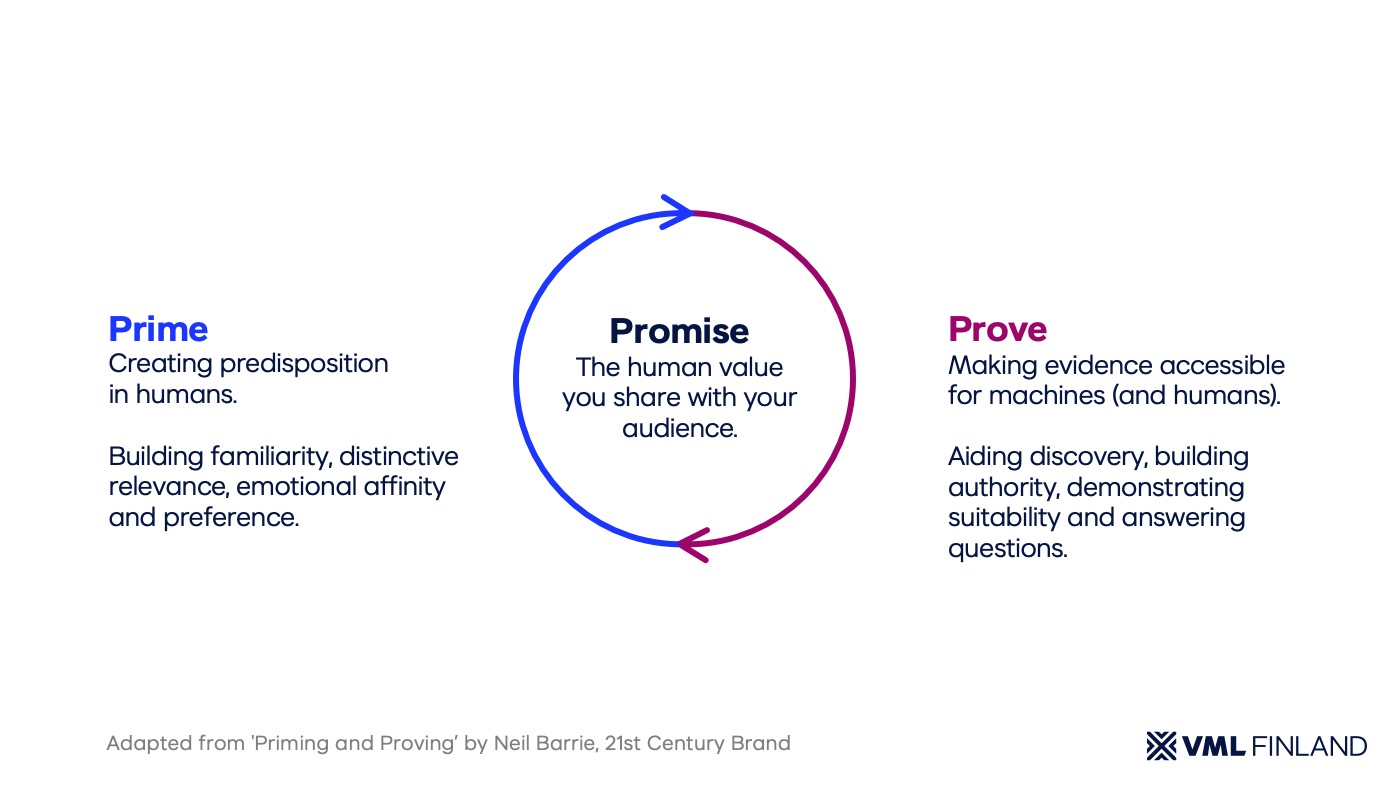
To build a brand that works for both audiences in tandem, here’s a way to organize your marketing as a flywheel. This version builds upon Neil Barrie’s original framing of “priming and proving”.
Promise: the axis of the flywheel is the promise your brand gives to customers. It’s what all activity revolves around. In defining your promise, anchor it to one or more fundamental human values that people seek from your category, distinct from those claimed by your competitors. Express it simply – in very human terms – so that colleagues beyond marketing can apply it practically to their own areas.
Prime: This is activity focused on building affinity and preference in people. What activities you choose will vary. But to create recall effectively, there are three principles from cognitive research you should adhere to: be distinctively relevant, coherent over time and rich in experience.
Prove: Make the evidence for your promise easy for machines (and people) to access, and increase its authority. Three principles to follow: ensure your site’s infrastructure is easy for AI to read; focus information on addressing the intent of AI users’ questions, not just keywords for search engines; and build influence through presence and advocacy in sources which AI trusts.
Where to start
Always start from whether your brand promise is clear, relevant and distinctive. Then ask, are your brand and marketing really delivering on the three Priming principles as well as it should? Are you being recommended by AI?
To find out how well optimized your brand is for humans and AI, contact VML Finland for an assessment.
-
Stuart Barnes is Head of Strategy at VML Finland, which specializes in global marketing communications for Finnish B2B brands.
He has previously delivered global strategies for brands including Clarks Shoes, BBC, Mercedes Benz and LEGO Education.
-
Check out the Aamukahviseura's recording of October 20th where Stuart also spoke about the subject: How can B2B marketeers make their brands work for humans and machines
Lisää
Blogit
-kategoriasta